Better Hardware, Better Health
How Improved MRI Technology for Brain Imaging Is Contributing to Better Diagnostic Options for Patients Worldwide
Professor Dr Boris Keil of the THM University of Applied Sciences is dedicated to advancing medical imaging technologies, particularly magnetic resonance imaging (MRI), to address global health challenges posed by neurodegenerative diseases such as Parkinson’s. His research focuses on improving diagnostic processes and developing effective treatment options for the millions of people affected by these conditions.
He leads two innovative initiatives:
- The first initiative, ADMIT (Advanced Medical Physics in Imaging and Therapy), is a cross-site collaboration that combines advanced imaging techniques with therapeutic strategies to enable early diagnoses and effective treatments for various cancers and neurological diseases. A key aspect of ADMIT is improving the usability of MRI for patients with deep brain stimulation (DBS) implants by minimizing interference caused by magnetic fields.
- The second initiative, “Brainmapping Technology,” aims to translate research findings into practical applications. Professor Keil’s team is developing new hardware architectures for MRI systems to improve the acquisition of high-quality neural brain imaging data. This work supports the Human Connectome Project, which maps brain connectivity to gain a deeper understanding of brain function.
Both projects highlight the importance of collaboration in advancing innovation. Partnerships between the universities in Central Hesse and renowned institutions such as Harvard and Yale enable the rapid implementation of new technologies into clinical practice – ultimately improving diagnostics and treatment for patients worldwide.
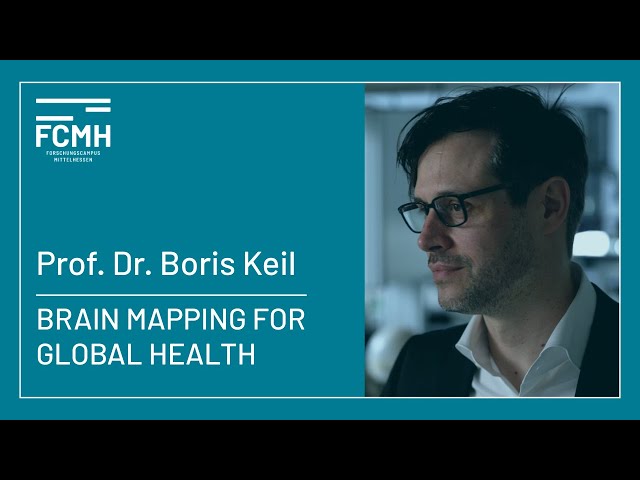
We interviewed Professor Boris Keil to gain a deeper understanding of what drives his work. Take a look at the short version here, or continue reading the full interview below:
Could you briefly explain what the LOEWE Transfer Professorship “Brainmapping Technology” actually is?
The LOEWE Transfer Professorship “Brainmapping Technology” builds on my many years of work and research findings. Its goal is to transfer the instruments and hardware solutions developed in our laboratories into industrial and clinical applications. This takes place within the framework of the Human Connectome Project – a project initiated by the Obama administration as a continuation of the Human Genome Project of the Clinton era, with the aim of mapping the brain and better understanding it through new technological and translational approaches. Our research group is the only European scientific team involved in this project. Our task is to develop new hardware architectures for MRI systems in order to acquire high-quality neural brain images.
What new opportunities does the LOEWE Transfer Professorship offer you?
The opportunities that the Transfer Professorship provides are multifaceted. Normally, the development of new hardware or instruments for imaging or MRI culminates in a proof of concept that we publish. However, the transfer process begins exactly where this phase ends. The development of innovative medical technology products of high technological complexity – such as MRI – is often considerably more demanding than in other sectors. This means that the intended transfer outcomes must not only be developed and realized technically, but also clinically tested. Thanks to the funding from the LOEWE Transfer Professorship, we are establishing a transfer management position at the interface between our research team, industry, and clinical partners to address this specific challenge.
What goals are you pursuing within the framework of the LOEWE Transfer Professorship?
The objective of the Transfer Professorship is to ensure that the knowledge generated in our research is translated into market-ready products for the primary or secondary healthcare sector. We are focusing on transforming the current state of connectome MRI technology – which in many respects is still far from practical application – into directly applicable, practical knowledge. To achieve this, we work in a network of universities, clinical users, and industry partners. In this way, we aim to bridge the gap between initial scientific findings and their economic and societal usability. In the long term, the MRI technology of the Connectome scanner is to be further developed into a certified medical device that becomes widely used in clinical practice and benefits society. In the medium term, subsystems – such as signal detectors, MRI field monitoring, or gradient technology – are to be scaled and externalized in a way that makes them compatible with existing clinical MRI scanners.
In what way does the scientific community benefit from this project, and particularly your research?
The scientific added value of the Transfer Professorship “Brainmapping Technology” is primarily application-oriented: We are developing new technologies to advance imaging techniques in such a way that both data acquisition speed and sensitivity are increased. This will initially support basic research and help address fundamental questions about the functioning of the human brain. “Brainmapping Technology” is intended to contribute to a better understanding of brain connectivity. Ultimately, however, the improved imaging techniques should also be used in clinical applications. With the Transfer Professorship, we aim to build a bridge between the highly application-driven science of instrument development and basic research in the neurosciences.
And what concrete societal benefits can your research provide within the framework of the LOEWE Transfer Professorship?
The concrete societal benefits of the technologies we are developing still lie in the future, as we are currently at the beginning of the project and are only now evaluating what is possible. In my opinion, however, the potential of our project is very high: We are not only helping to develop a new instrument to improve human health, but we are also paving the way for a new kind of brain imaging that will likely lead to groundbreaking insights into our “mental” self. I see a parallel here to the Human Genome Project: It, too, began as basic research and has now reached a point in society where most people at least have a basic understanding of genetics. I can well imagine that in 20 or 30 years we will be able to create widespread societal awareness of how connectivity in the brain works, what role the so-called connectors in the brain play, and how we can use this knowledge.